
“Outlined against a blue-gray October sky, the Four Horsemen rode again. In dramatic lore they are known as Famine, Pestilence, Destruction and Death. These are only aliases. Their real names are Stuhldreher, Miller, Crowley and Layden. They formed the crest of the South Bend cyclone before which another fighting Army football team was swept over the precipice at the Polo Grounds yesterday afternoon as 55,000 spectators peered down on the bewildering panorama spread on the green plain below.”
These words were written by sportswriter Grantland Rice after Notre Dame’s Irish beat up on their rival, Army 13-7 on October 18, 1924. Notre Dame under Knute Rockne was playing a different kind of football in in 1924. There was movement on the line. There were switches on the blocks. There were feints and there were fakes. But they also had 4 young men that would ride their way into college football history.
Harry Stuhldreher may have been the smallest of the 4 men to drive this amazing offensive, but he certainly didn’t act that way. As a young boy he knew a young Knute Rockne as a player for his hometown Massillion Tigers in Ohio. When Rockne’s playing days were over he became the coach at a small Catholic school in South Bend, Indiana. Stuhldreher, who had always admired Rockne went there to play for him. Rockne would call him the best of the Four Horseman, and as quarterback he called the plays. He was described as cocky and arrogant by some, as a leader with confidence by others. Either way, he was the director of the offense that turned the Irish into college football royalty.
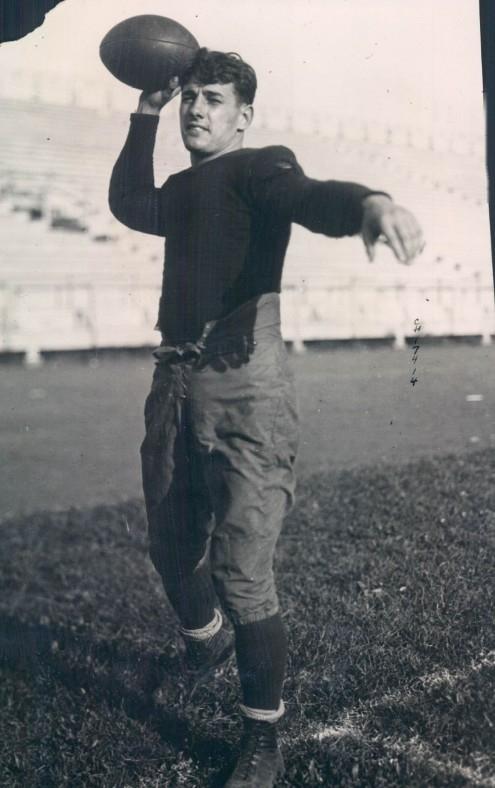
The most dangerous of the Four Horseman, according to their coach, also hailed from Ohio. Don Miller of Defiance was the half back. But his prospects weren’t promising when he stepped onto the tryout field his freshman year of 1921. Rockne, actually couldn’t believe he came out for football, he was so small, a measly 5’11” and only 160 lbs. But when your fast, it doesn’t matter much. If Miller got past the defense, he was nigh unstoppable. Rockne later admitted, “Once in the open field, he was the most dangerous of the Four Horsemen. I would have to call him the greatest open-field runner I ever had.”

But Miller wasn’t the fastest of these four, the fastest was Elmer Layden. Not only did he star on the offensive end but was an interception machine on the defensive side. Layden would be the first of the horsemen enshrined in the Football Hall of Fame. He could run a 10-second 100m dash. He was also the tallest of the bunch, the only one to reach the 6 feet mark and 162 lbs. Hailing from Davenport, Iowa, Miller would be the hero in their last game.
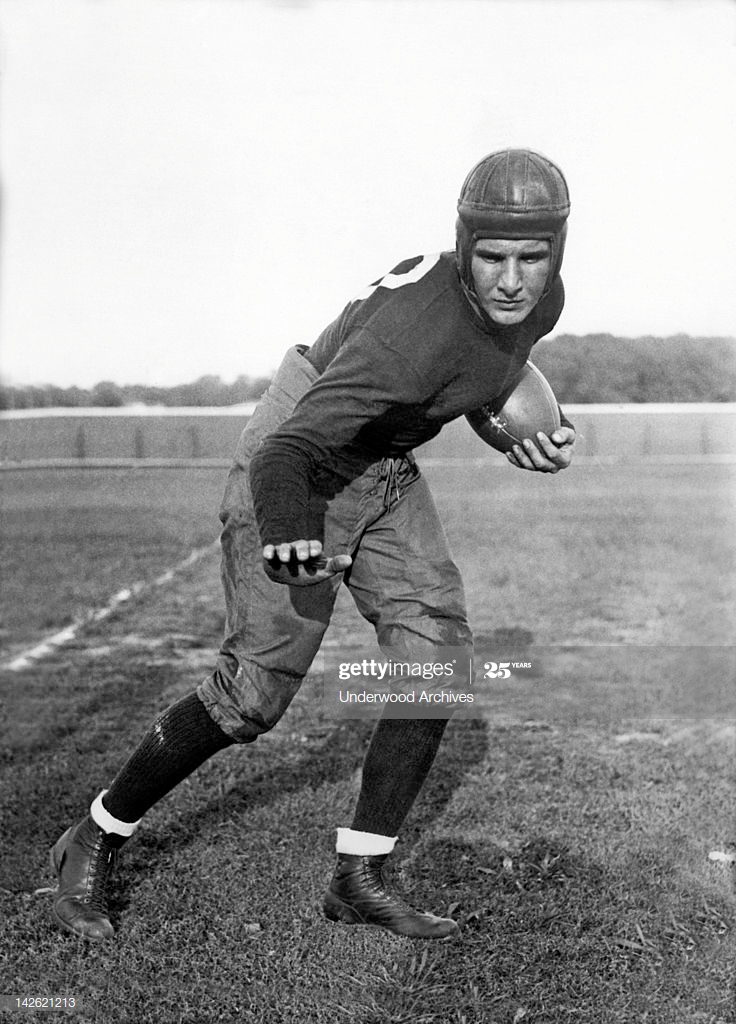
The opposites of speedy Miller and Layden and cocky Stuhldreher was “Sleepy Jim” Crowley of Chicago, Illinois. Crowley graduated from high school in Green Bay, Wisconsin and walked with stooped shoulder and a slow pace. Not one to immediately draw the eye of his coach, or the defense. But as the halfback for Notre Dame he was described by his coach as “the nerviest”.
But this story starts prior to any of these four men making it to South Bend, it starts with Knute Rockne being promoted from assistant to head coach in 1918. Notre Dame was something prior to Rockne’s tenure, but they were something else with him. They had forged a rivalry with Army during Rockne’s playing days with the Fighting Irish. But when he took over head coaching, that rivalry was elevated to one of national prominence.
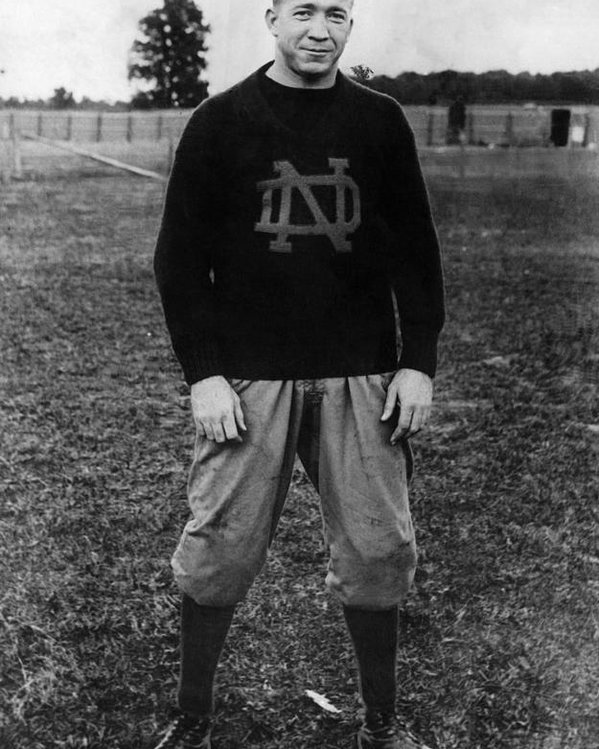
Rockne’s first season in 1918 he posted a 3-1-2 record. College football only had 72 teams, the Irish finished 23rd. The next season, he would win his first, unofficial, National Title when his team went 9-0. They would be perfect again in 1920 with only a loss against Iowa in 1921. So it was as the premier team that these four freshman walked onto the practice field to try and play for the Irish. Rockne had proven he was a winner in these early years of college football. But still, he stood behind Pop Warner, the father of American football, the head coach of Carlisle Indian school and the greatest athlete of all time, Jim Thorpe.
The Four Horsemen had an uneventful first year, they went 8-1-1 and finished 14th in the country. But in the four years since Rockne had held the head coaching position college football had exploded from 72 teams to 109. They held their first 4 opponents to 0 points winning 46-0, 25-0, 20-0. But the rivalry was set for November 11th, the Army game. They had three more wins coming into that game having only given up 10 points but with the Horseman’s offense scoring 74 points.
Rockne’s first season in 1918 he posted a 3-1-2 record. College football only had 72 teams, the Irish finished 23rd. The next season, he would win his first, unofficial, National Title when his team went 9-0. They would be perfect again in 1920 with only a loss against Iowa in 1921. So it was as the premier team that these four freshman walked onto the practice field to try and play for the Irish. Rockne had proven he was a winner in these early years of college football. But still, he stood behind Pop Warner, the father of American football, the head coach of Carlisle Indian school and the greatest athlete of all time, Jim Thorpe.
The Four Horsemen had an uneventful first year, they went 8-1-1 and finished 14th in the country. But in the four years since Rockne had held the head coaching position college football had exploded from 72 teams to 109. They held their first 4 opponents to 0 points winning 46-0, 25-0, 20-0. But the rivalry was set for November 11th, the Army game. They had three more wins coming into that game having only given up 10 points but with the Horseman’s offense scoring 74 points.
The Irish would face Army that November day in West Point and the game would end in a 0-0 tie. This was Army’s second tie of the season having tied 7-7 with Yale, another powerhouse of the era. The Black Knights would not lose a game but finish 10th in the country at 8-0-2.
The Irish would finish the 1922 season with a loss to Nebraska. Nebraska would prove spoiler again in 1923. Again the Irish outclassed most of their opponents. They would beat Army 13-0 in the third week and that was about as close as anyone came, until they faced the Cornhuskers. Nebraska won 14-7 to give the Irish one loss and a 10th place finish.
The Horseman had proved their ability to play with their rival, Army. They had amassed an impressive record of 17-2-1 as Irish. But both the National Title and the Granddaddy of the All had remained elusive.
1924 was their last season. It was this season that Grantland Rice would enshrine them in football legend with the nicknames “The Four Horsemen”.